╳

Home



 2026-10-23

Miniature Enamel Painting: The Rarest Craft in Watchmaking
Miniature enamel painting stands as the representative achievement of Western enameling. Today, very few schools still teach this traditional technique, and high-quality enamel work has become increasingly rare — true collector's treasure.
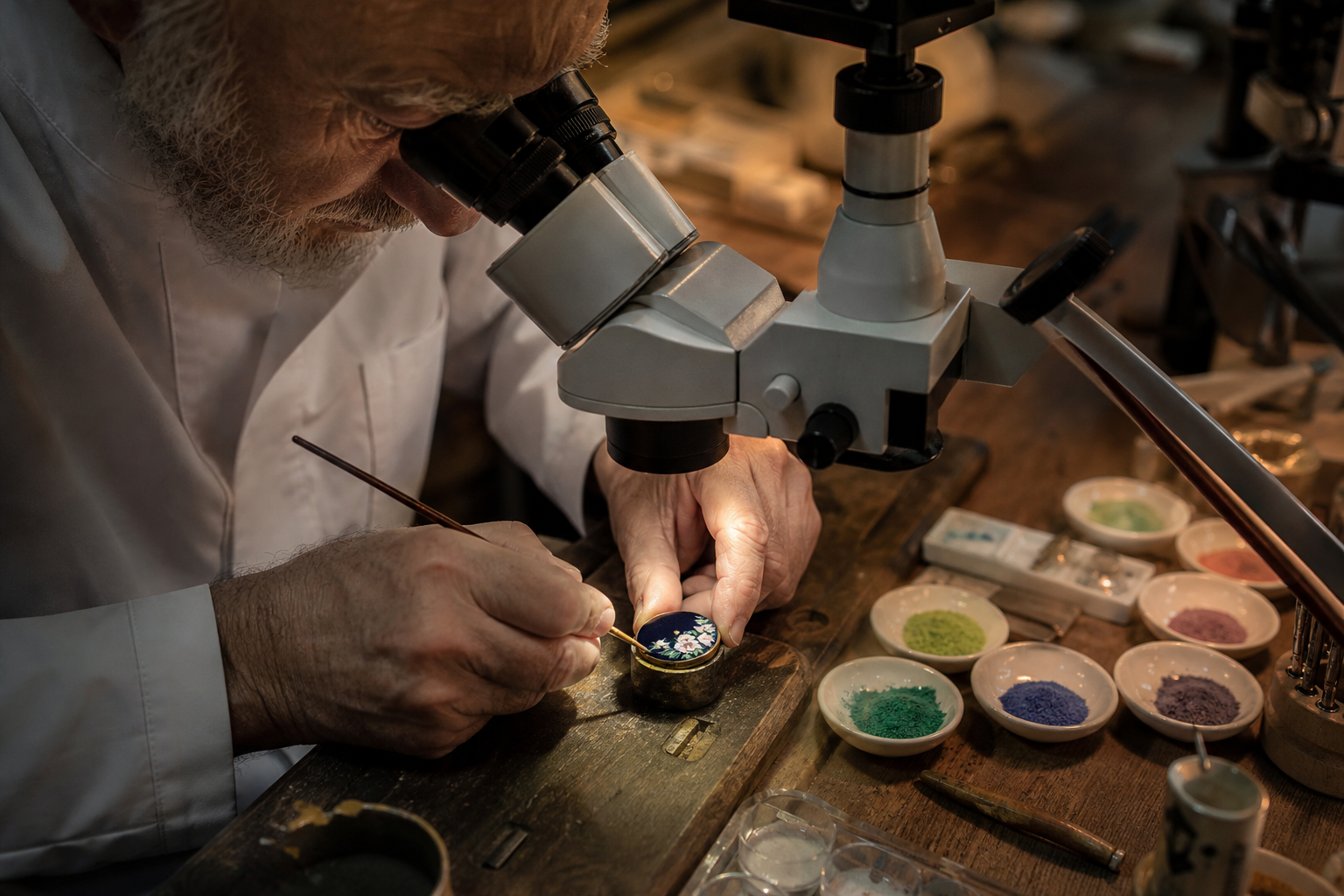
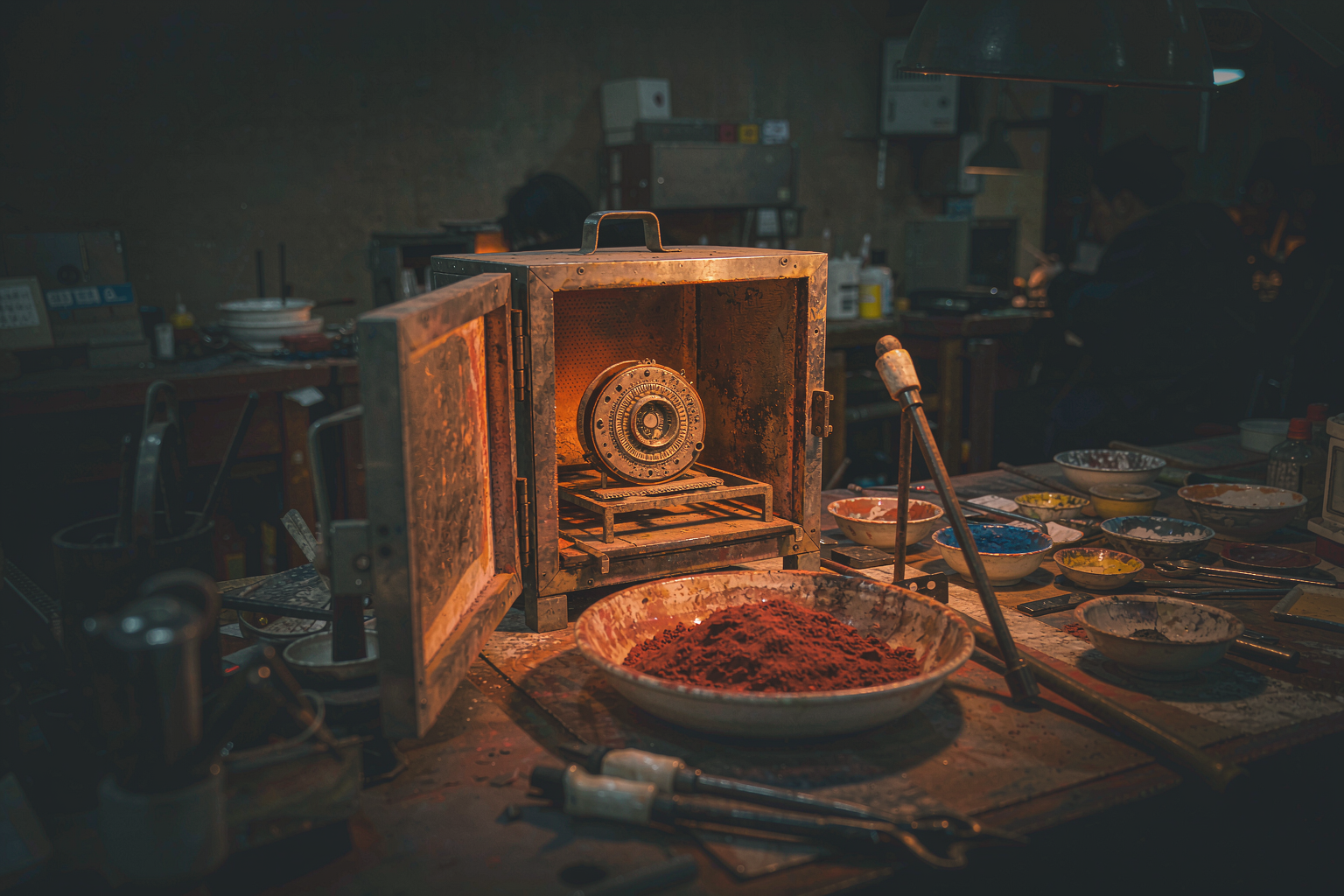
The process begins with a base dial fired with a layer of opaque enamel glaze. Only then does the painting begin, followed by kiln firing. The enamel painter works with a specially made needle brush, aided by a high-magnification microscope, painting with painstaking care over weeks or even months. The piece is then fired at high temperature so the colors deepen progressively until they radiate a dazzling brilliance. Because each glaze responds differently to heat, the work typically demands multiple layers of color combined with multiple firings.
---
## What Is Miniature Enamel?
Miniature enamel painting — known in the trade as *Enamel Miniature*, or painted enamel — is the most difficult of the three major enamel categories (the other two being cloisonné enamel and champlevé enamel).
The technique originated in the mid-15th century in the Flanders region, at the crossroads of Belgium, France, and the Netherlands. By the late 15th century, Limoges in central-western France — building on its established champlevé tradition — had developed into the great center of painted enamel. Early production focused on religious subjects, gradually evolving into decorative objets d'art.
As trade between East and West intensified — particularly after 1684, when the Qing court pacified Taiwan and lifted the maritime ban — Western goods began flowing into China. Western enamel entered through ports such as Guangzhou, where workshops were established on site. The product became known as *yangci* ("foreign porcelain"); within the imperial court, it was called *Guang falang* ("Canton enamel").
---
## The Decline of a Once-Thriving Art
By the early 20th century, the once-flourishing craft of miniature enamel had fallen into decline. Producing a single miniature enamel dial was immensely time-consuming, and as pocket watches gave way to wristwatches, the golden age of the pocket watch passed into history. The great masters of miniature enamel painting dwindled with it.
Today, only about **ten masters worldwide** are capable of watch-grade enamel painting, working out of fewer than **four workshops**. This makes miniature enamel painting — celebrated as one of the **seven great crafts of Geneva watchmaking** — all the more precious.
## How a Miniature Enamel Dial Is Made
The base plate is first coated with an anti-deformation enamel glaze. To help the dial withstand the extreme heat of firing, several layers of white glaze are then applied to the metal plate before painting begins.
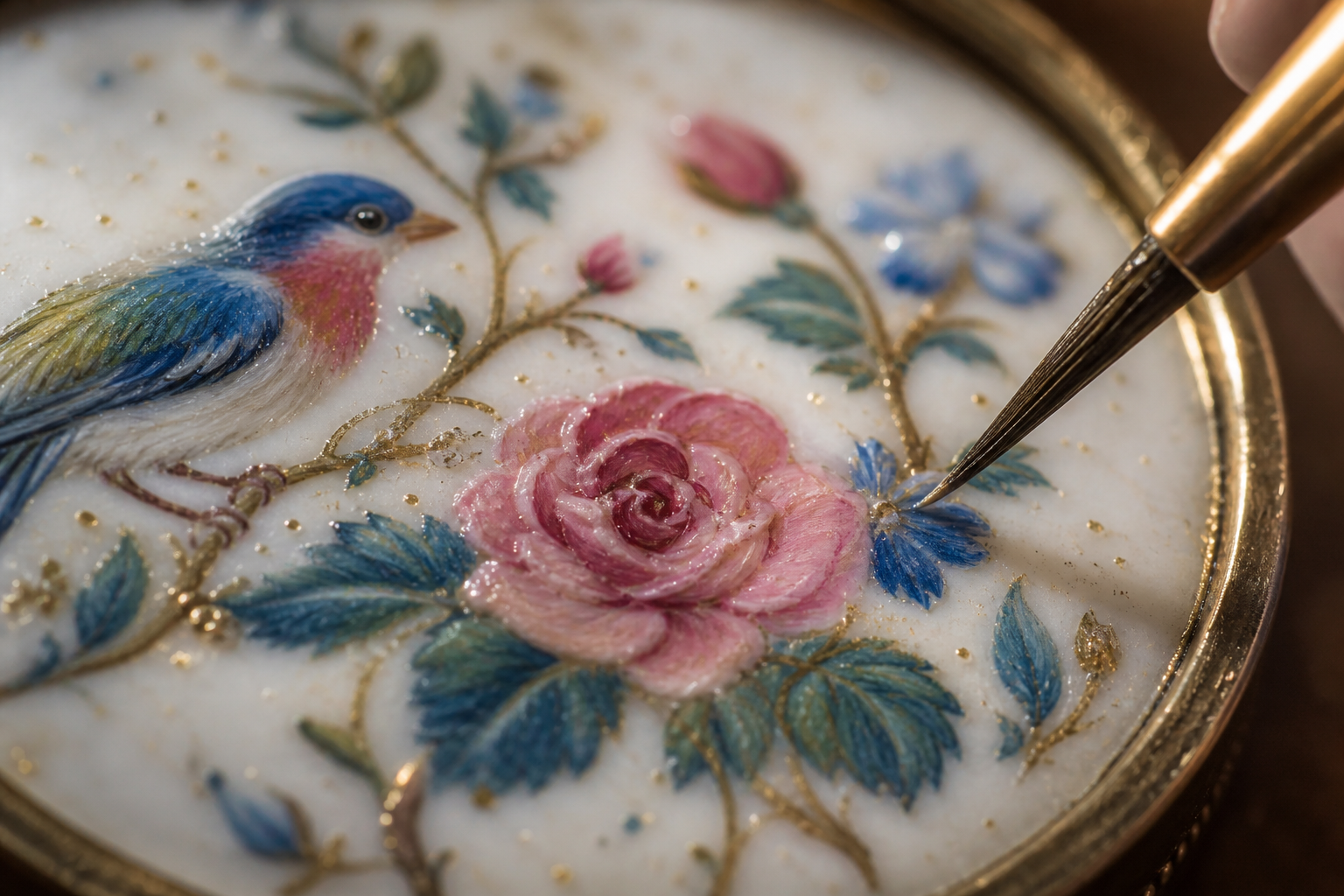
The enamel master works with a **sable single-hair brush**, laying down layer upon layer of colored glaze in extraordinarily fine strokes to build a delicate image. This is where color mixing becomes the greatest test of skill: over-blend the colors and the pattern turns muddy after firing, ruining the composition. The painter therefore completes one small area, fires it, then moves on to the next area and fires again — repeating this cycle until the work is done.
The final step is the application of several layers of colorless transparent glaze, which enhances the three-dimensional depth of the image. A single miniature enamel dial may require **dozens of separate firings**; a failure at any one of them — crazing, a botched color blend — destroys the entire piece.
This is why miniature enamel is so precious. A fine miniature enamel watch can easily command **millions**.
## The Secret Techniques No One Shares
Although enamel techniques now have their own standardized process specifications, when it comes to actual execution, every brand and every enamel master holds their own closely guarded "secret methods" — never shared outside.
This is precisely why enamel watches produced with ostensibly identical techniques still show subtle, "felt-but-never-explained" differences from brand to brand.
---
## The Masters Behind Today's Rarest Dials
In the Swiss watch industry today, only a handful of brands can still produce miniature enamel. Beyond the few — such as Jaquet Droz and Ulysse Nardin — that maintain their own dedicated enamel teams, it is not uncommon for several brands to share the same enamellist.
The most celebrated name in enamel today is **Anita Porchet**, who signs her work **"A. Porchet."** Countless exceptional enamel watches from Patek Philippe, Vacheron Constantin, Cartier, Piaget, and Hermès have come from her hand. She trained under **Suzanne Rohr**, who in turn studied under **Carlo Poluzzi** — both towering figures in Geneva's enamel-painting world.
Her recent works include miniature enamel watches for Hermès and Chanel. For Hermès, she created a pocket watch incorporating the **paillonné** technique, in which tiny gold particles appear to "float" naturally within the transparent enamel. For Chanel's "Folding Screen" enamel watch, she took as her theme the Chinese screens in Mademoiselle Chanel's boudoir, rendering the flowers and birds across them with a delicacy akin to embroidery.
Another master who must be mentioned is **Miklos Merczel**, who creates for Jaeger-LeCoultre. The dial of the celebrated Jaeger-LeCoultre Lotus Master Minute Repeater is his work. It is thanks to this master that Jaeger-LeCoultre is able to offer bespoke watch customization. The brand's famous Reverso — with its reversible case back — provides an ideal canvas for miniature enamel, and has given rise to countless Merczel classics.
He once observed that the greatest charm of miniature enamel lies in this: when the marks of time gradually creep across the movement and the case, the dial alone remains as radiant as the day it was made.
---
**A note on sourcing:** Brand and artist references in this article are presented as historical and editorial record of the craft, and do not imply any affiliation or endorsement.

2F, Building A, Shimei Industrial Park, Dalang Town, Longhua District, Shenzhen, China


 The History of Watch Straps: From Rope to Rubber | Evolution Guide